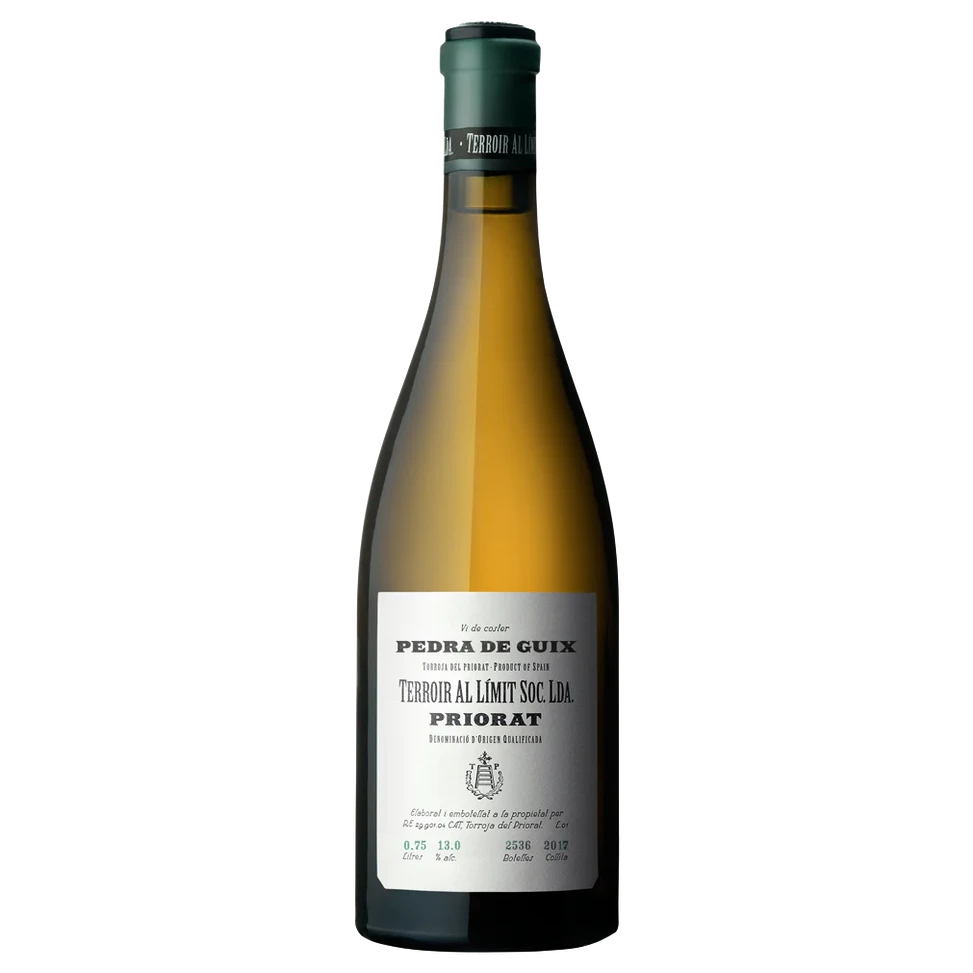
This is a Vi de Coster, the equivalent of 1er Cru. As we have said before, this is one of the most mineral, sculpted whites we know. It tastes as if the wine was tapped directly from pure rock—which, of course, it was. Forget about how rare white Priorat is; Pedra de Guix gives the great whites of the world a run for their money.
This is a blend of three varieties from three villages: Poboleda (on schist) provides the Grenache Blanc; Torroja (on alluvial soils) the Macabeo; and the chalky/gypsum soils of El Lloar contribute the Pedro Ximenez. The old vines of these sites are between 50 and 80 years old. The grapes are gently basket-pressed over the course of several hours and the juice ferments wild in diamond-shaped concrete vats, where it matures for 11 months. With most of the grapes today pressed off their skins prior to fermentation, the style now hinges on purity and tension rather than development, as was the case in the past. This comes without any sacrifice to the salinity and structure derived from its rocky soils.
In just twenty years Dominik Huber has created something unique in Priorat and, arguably, in Spain as a whole. While these Catalan hills south of Barcelona are no stranger to critically fêted wine, Huber’s transparent, pared-back examples are both striking and radical in the Priorat context. His is a style of Priorat that has seen critics and other wine people scrambling to offer plaudits and comparisons.
Through many years of trial and error, Huber has managed to evolve a style of Priorat that is all about mesmerising finesse, purity and freshness. With old-vine Carignan and Grenache as the conduit for the reds, Huber has now shown the wine world that Priorat wines do not have to be heavy, thick and oaky. And he has also shown that the whites of the region can be every bit as great as the reds. They are beautiful, textural and mineral whites that taste as if they’ve been tapped directly from Priorat’s rocky soils.
Dominik Huber’s wines have redefined what we all once thought was possible from the vineyards of Catalonia.
Huber’s vineyard selection has involved a search for high-altitude, old-vine plots that allow him to harvest ripe fruit with maximum freshness. He practices biodynamic viticulture and picks as early as possible (he would pick even earlier if the DOCa allowed it). Huber uses whole-bunch (there’s no destemmer at the winery) and carbonic fermentation to significant effect, favouring an infusion-over-extraction approach. The wines are raised in large-format oak and concrete. All this lends Huber’s wines an almost Burgundian-like shape and structure, generating vibrancy and succulence, with the emphasis placed squarely on the glowing, stony, mineral essence of Priorat’s soils.
Terroir al Límit is a Domaine in a constant state of progress, forever seeking to refine and improve their way of working. The arrival of head winemaker Tatjana Peceric to assist Dominik Huber, and the quality emanating from the Montsant project, Terroir Sense Fronteres, are two significant examples in point. In recent years, the range has been downscaled to allow more focus on what Rajat Parr has termed the Domaine’s “maniacal farming practices”.